
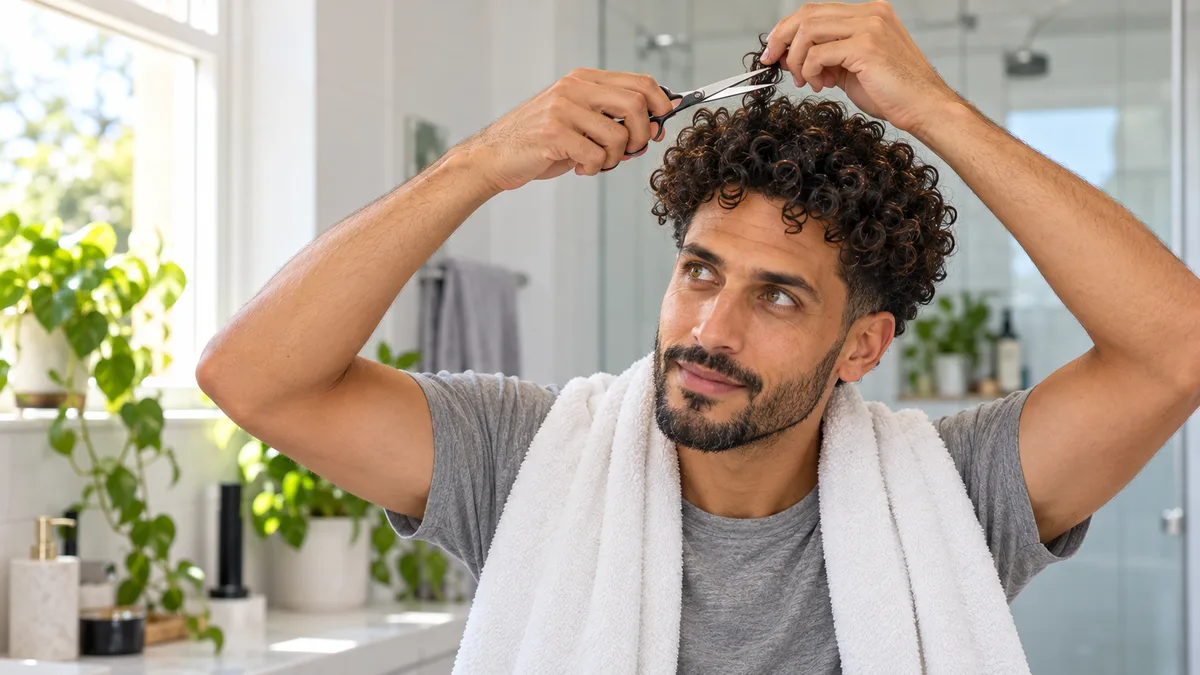
How to Cut Men’s Curly Hair at Home: The Easy Three-Pass Method
Curly hair keeps a secret from whoever is cutting it. Wet, it hangs long and almost straight. Dry, it pulls back up into its real shape, often an inch or more shorter. That gap is why people worry when they first try to cut men’s curly hair at home, and it is also good news: most home-cut problems come from a few habits, not from unsteady hands.
This guide gives you one plan you can repeat every time you cut men’s curly hair at home. You decide the finished length first, then reach it in three small passes instead of one big cut. Along the way you will see how much your curl type shrinks, which tools are worth having, the clipper guards that are safe for a first taper, four easy cuts with real lengths, and the signs that mean it is time to stop and see a barber.
One honest note before you start: a home cut is for keeping a shape you already like, not for inventing a new one. If you want a big change, let a barber build the shape once. Then use this guide to keep it looking fresh between visits.
Trim at Home or See a Barber First?
The right answer depends on the job, not on how brave you feel. Before you cut men’s curly hair at home, run through these two short lists.
Cut at home if all three are true:
- You already have a shape you like, and it has simply grown out.
- You want to take off about an inch or less from the top.
- The sides only need the same guard they had last time, or a longer one.
Book a barber if any one is true:
- You want a new style, or more than two inches gone from the top.
- You want a skin fade, a high fade or a hard part line.
- Your hair is tight type 4 coils and has never been shaped by a professional.
- A home cut has already gone wrong and you want it fixed.
A barber visit is not a failure. Think of it as the cut that sets the shape, and every home trim after it as upkeep.
How Much Do Your Curls Shrink?
Shrinkage is the single number that decides how much you can safely take off when you cut men’s curly hair at home. Find yours with a quick stretch test before your first cut, because it changes everything that follows.
Take one dry curl from the crown. Hold the end and gently pull it straight beside a ruler, then let it go and see where it settles. The difference between the two is your shrinkage. Do it on the top and the back, since many men have tighter curls at the nape.
| Curl type | How it looks dry | Usual shrinkage | Leave extra if you stretch it to cut |
|---|---|---|---|
| Waves (2A to 2C) | Loose S-bends that lie fairly flat | 10 to 20% | About 1/4 inch |
| Loose curls (3A) | Wide, bouncy loops | 25 to 35% | About 1/2 inch |
| Tight curls (3B to 3C) | Springy ringlets, pencil to straw width | 40 to 50% | About 3/4 inch |
| Coils (4A to 4C) | Tight coils or zig-zags | 50 to 75% | 1 inch or more; trim only |
The safest habit is to skip stretching altogether. Cut each curl where it naturally sits, and what you see is what you get.
Tools Worth Having
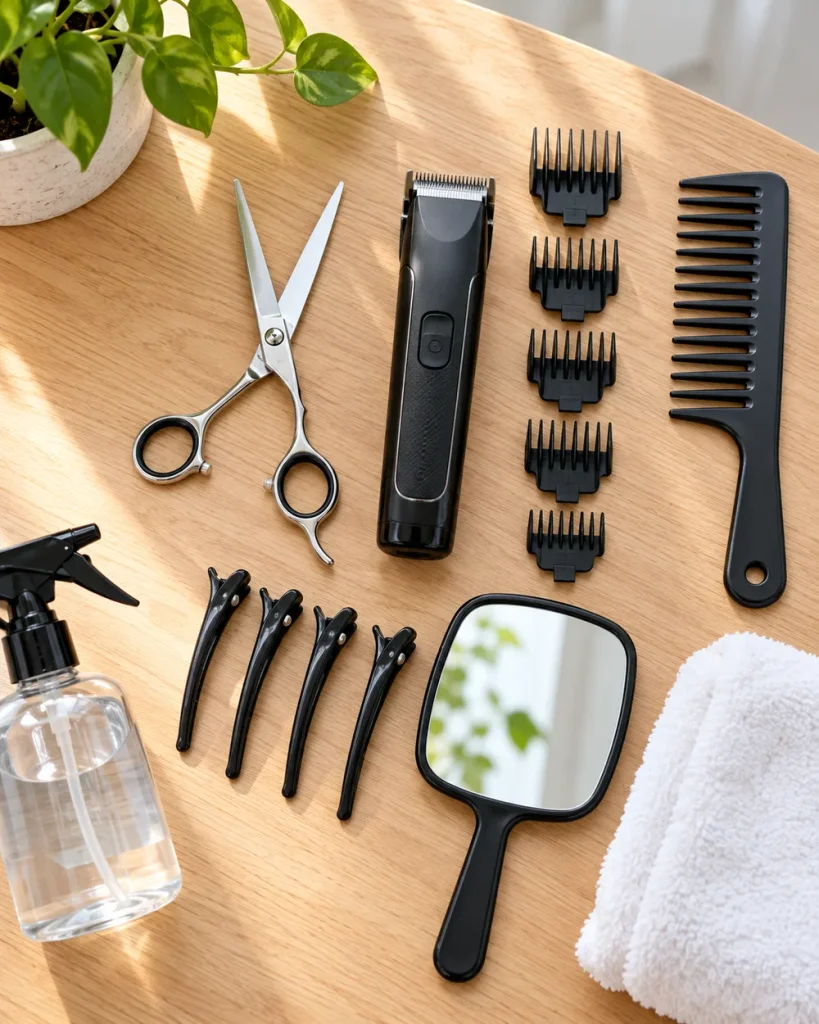
You do not need a barber’s station to cut men’s curly hair at home, but you do need sharp tools. Dull blades fold and crush curl ends instead of slicing them, and a crushed end frizzes for weeks.
- Haircutting shears, 5.5 to 6.5 inches. Kitchen or craft scissors are too thick and too dull for curls.
- Clippers with guards from #2 up to #6 or #8. The guards are your measuring system, so the more lengths you have, the safer the taper.
- A wide-tooth comb. It lifts and separates curls without pulling them straight.
- Four sectioning clips. They keep finished areas apart from the ones still waiting.
- Two mirrors, or a phone propped up to film the back. The back of the head is where most home cuts go wrong.
- A spray bottle, a towel or cape, and a soft neck brush. The spray is for styling at the end, not for cutting.
Leave thinning shears and razors for later. Both remove hair faster than a beginner can judge, and curls show every mistake they make.
The Three-Pass Method, Step by Step
Every step here is built on the one idea that makes it safer to cut men’s curly hair at home: reach your finished length in three small passes, never one big one. The first pass removes obvious bulk, the second builds the shape, and the third only tidies. If the hair already looks right after any pass, you are done.
Step 1: Decide the Finished Length Before You Start
With dry hair, measure the top from the scalp to where the curls sit now. Then decide where you want them to end, for example from 4 inches down to 3. That one inch is your whole budget for the top, split across three passes, so no single pass takes more than about a third of an inch.
Do the same for the sides: pick the guard you will finish with, and plan to start one size longer.
Time: 5 minutes. Watch for: deciding as you go. A cut without a target keeps creeping shorter.
Step 2: Wash, Skip the Product and Let It Dry Fully
Wash and condition as usual, then let the hair dry completely in its natural shape. Leave out gels, creams and blow-drying. You want to cut the curls you wear every day, not a styled version of them.
While it dries, notice where it parts on its own, where any cowlick sits, and which areas are fuller or flatter.
Time: 30 to 45 minutes of drying. Watch for: cutting while it is still slightly damp, because damp curls still hang longer than dry ones.
Step 3: Clip the Hair Into Four Zones
Split the hair into the top, the left side, the right side and the back, and clip each one away. Very thick hair may need the top split into a front and a back section too. Work the top first, because it sets the length everything else is measured against.
Time: 5 minutes. Watch for: skipping this on short hair. Short cuts have the least room to hide a mistake.
Step 4: Take Off the Obvious Bulk on Top (First Pass)
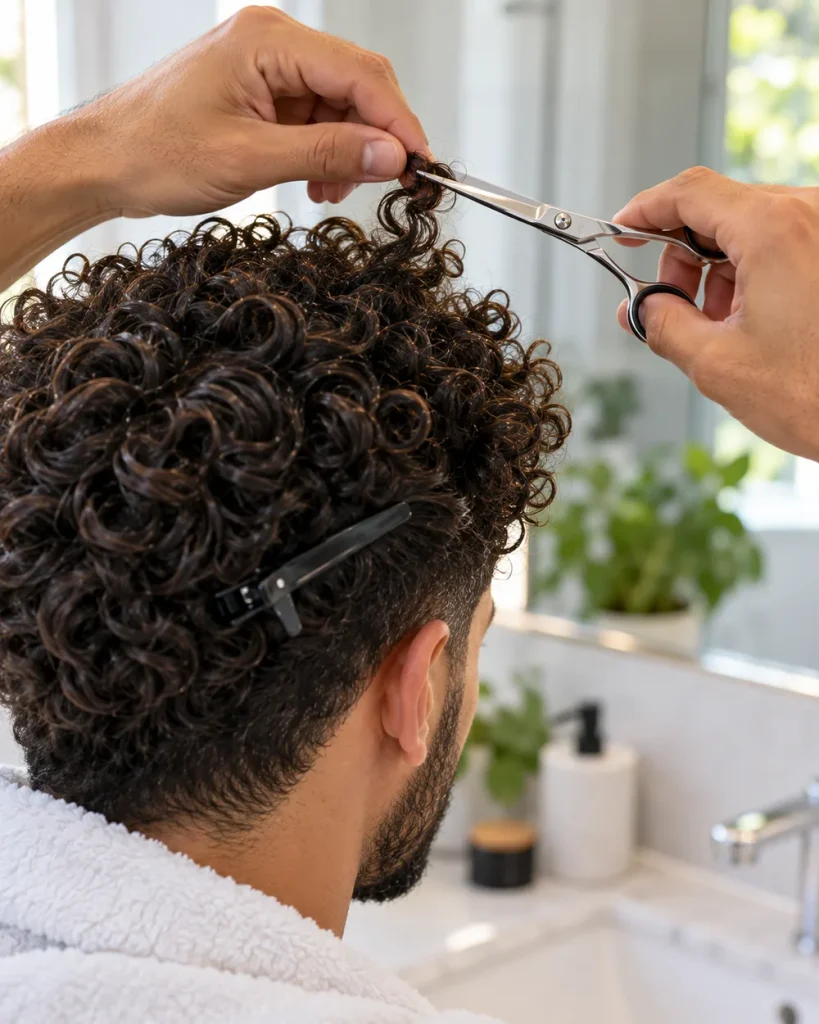
Release the top section. Pick up one curl or a small clump between two fingers right where it sits, without pulling it straight, and snip a third of your planned length from the end. Move around the whole top once before you go back to any area.
After the round, step back and look from the front and both sides. A curl that looked long earlier often blends in once its neighbours are trimmed.
Time: 10 to 20 minutes. Watch for: combing curls out before cutting. It breaks the clumps apart and hides their real length.
Step 5: Shape the Sides and Back With a Long Guard (Second Pass)
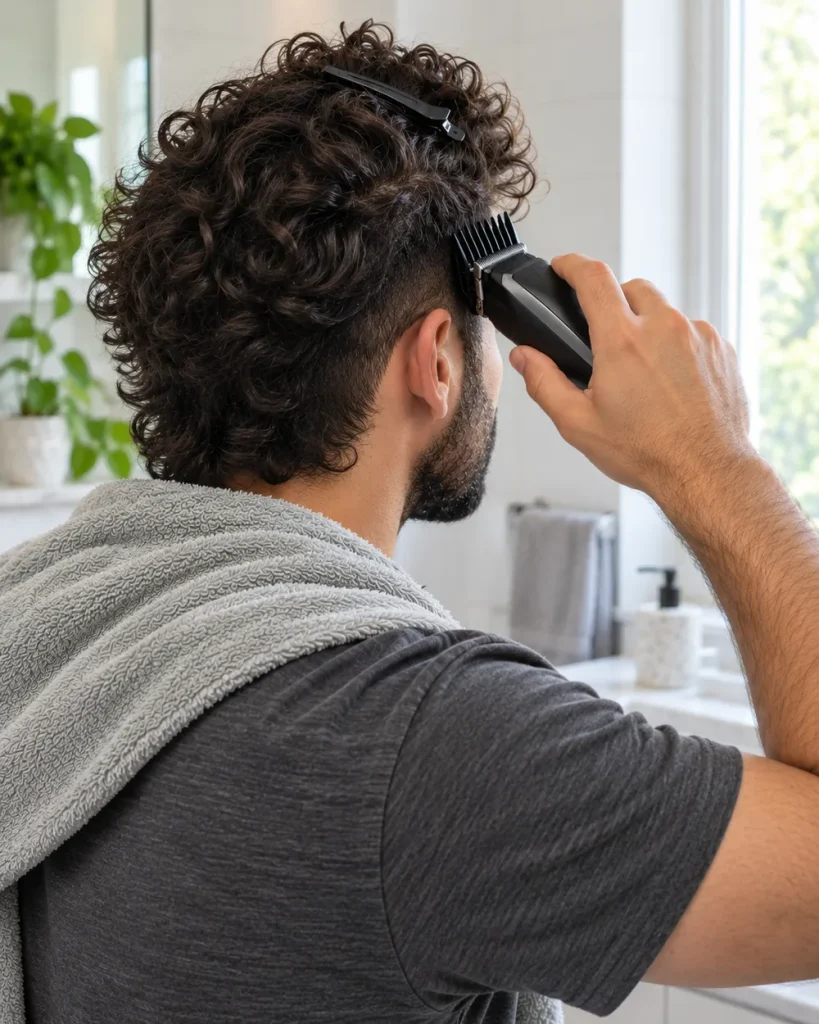
A taper gets gradually shorter from the top of the sides down to the hairline, and it is the safest clipper work for a beginner. Start with a #5 or #6 guard on the upper sides and back, then go one size shorter below the top of the ear. Move the clippers upward against the growth in short, overlapping strokes, flicking out at the end of each one.
Keep each guard change at the same height on both sides. For a clear picture of how low, mid and high tapers sit on the head, our guide to boys side part fade haircuts shows the same placement that works on adult curls.
Now make your second pass on the top, taking the next third of your planned length.
Time: 15 minutes. Watch for: starting with a #1 or #2. Short guards leave patches that can only be fixed by going even shorter everywhere.
Step 6: Blend Where the Top Meets the Sides
The line where long curls meet the clippered sides is what gives a home cut away. Hold a comb at an angle against the head and trim only what pokes through its teeth, with scissors or clippers, working upward in short passes.
Check from the front, each side and the back after every few passes. Curls are forgiving here: the texture hides soft lines that would show on straight hair.
Time: 10 minutes. Watch for: blending only the parts you can see. Film the back with your phone.
Step 7: Tidy the Neckline, Ears and Stray Curls (Third Pass)
Use a trimmer or the tip of your shears to tidy around the ears, the sideburns and the neckline. Follow the natural curve of the nape; a squared-off neckline shows every bump as it grows. Then make your third pass on top, and only on curls that clearly stick out.
Time: 5 to 10 minutes. Watch for: rushing around the ears. The skin there is thin and nicks easily.
Step 8: Style It, Wait a Day, Then Judge
Add a little leave-in or curl cream, scrunch, and let it air-dry or diffuse on low heat. Look at the result by a window or outside, front, sides and back.
Curls settle over the next 24 to 48 hours, so leave small doubts until then. If one side is clearly longer after that, trim a quarter inch from that side only, dry, and stop.
Time: 10 minutes, then a day of patience. Watch for: fixing the cut three times in one evening. Each fix costs length you may want back.
Four Easy Cuts to Try at Home
If this is your first time trying to cut men’s curly hair at home, pick one of these rather than inventing a shape. Each lists the curl types it suits, real lengths and guards, and the words to use if you decide to see a barber instead.
Curly Top With a Low Taper

Longer curls on top, short tapered sides, and a soft blend in between. This is the most forgiving home cut because the taper sits low and the curls on top hide small mistakes.
- Best for: Type 2C to 3C, and every face shape. The height on top lengthens a round face, while close sides slim a wide one.
- Top length: 3 to 4 inches, cut curl by curl.
- Sides: #5 on the upper sides, #4 below the top of the ear.
- Time at home: About 45 minutes.
- Trim schedule: Sides every 3 to 4 weeks, top every 6 to 8 weeks.
- Tell your barber: “A curly top at about 3 inches with a low taper, cut dry and blended soft.”
Rounded Curly Cut With No Clippers

The whole head is cut with shears into one rounded shape, a little shorter at the sides than on top. With no guards and no blend line, it is the lowest-risk cut in this guide.
- Best for: Type 3B to 4A curls with medium to thick density. Oval and square faces.
- Top length: 2 to 4 inches, depending on how tight the curl is.
- Sides: Scissors only, about half an inch shorter than the top.
- Time at home: About 40 minutes.
- Trim schedule: Every 8 to 10 weeks. It grows out evenly, so a missed trim is easy to live with.
- Tell your barber: “A rounded curly cut, scissors only, slightly shorter at the sides so it doesn’t go triangular.”
Short Curly Crop With a Textured Fringe

Short curls on top push forward into a loose fringe, with a neat taper below. It is quick to cut, needs almost no styling, and keeps wavy hair from looking flat.
- Best for: Type 2A to 3A waves and loose curls. Long and oval faces, since the fringe shortens the forehead.
- Top length: 1.5 to 2.5 inches, with the fringe left a little longer than the crown.
- Sides: #3 or #4, cut a quarter inch shorter at the hairline.
- Time at home: About 30 minutes.
- Trim schedule: Sides every 3 weeks, top every 5 to 6 weeks.
- Tell your barber: “A short textured crop with a forward fringe, point-cut ends, and a #3 taper.”
Longer Curls With a Light Shape-Up

For men growing curls to the chin or past it, the job is not a haircut but a careful shape-up. You keep the length and only remove split ends and the few curls that throw the outline off.
- Best for: Type 2C to 3B curls, and men growing their hair out. Square and heart faces.
- Length: Chin to shoulder; take no more than a quarter inch from any curl.
- Sides: No clippers. Shape around the ears with shears only.
- Time at home: About 25 minutes.
- Trim schedule: A dusting every 8 to 12 weeks.
- Tell your barber: “Keep my length, dust the ends dry, and shape the outline so the curls fall evenly.”
Mistakes to Avoid When You Cut Men’s Curly Hair at Home
Cutting wet hair. Wet curls can hang half again as long as they sit dry, and coils even longer. A cut that looks right in the shower can be far too short an hour later.
Cutting the full length in one go. One big snip on a stretched curl can lose two or three inches once it springs up. Three small passes keep you in control.
Thinning the bulk too early. Thinning shears break curl clumps apart, and the result is frizz instead of definition. Leave them until you have a few cuts behind you.
Using dull or crushing blades. Crushed ends split and frizz. The American Academy of Dermatology’s guide to hair styling without damage explains how rough handling and heat weaken hair, and gentle handling starts with clean, sharp tools.
Fighting your growth pattern. A cut that goes against a crown whorl or front cowlick needs effort every morning. Cut with the direction your hair grows, and it falls into place on its own.
Fixing Common Problems After the Cut
One side looks longer. Restyle the hair fully first, since curls can fake unevenness. If it is still uneven when dry, trim the longer side only, a quarter inch at a time.
A triangle shape, wide at the bottom. The sides and back are carrying too much weight. Take a little more from the sides with scissors, not from the top. If you are unsure, this is a quick barber fix.
A spot cut too short. Length cannot come back, so blend around it. Point-cut the nearby curls so the short spot fades into them, and let the next trim even it out.
Frizz and no definition. Frizz after a cut usually means dull blades or curls combed out while cutting. Condition well for a week; if the ends still frizz, trim them cleanly with sharp shears.
Keeping the Shape Between Cuts
A few small habits stretch the time between full cuts. Snip a single stray curl the moment it sticks out, rather than letting it grow into a new shape. Sleep on a satin pillowcase or a smooth cotton one, which flattens curls less. Refresh second-day curls with a light mist of water and a little cream instead of washing them every day.
Frequently Asked Questions
Can I cut men’s curly hair at home if I have never cut hair before?
Yes, if you keep the first cut small. Choose a shape you already have, plan to remove an inch or less, and use the longest guards. A trim is a safe first step; a new style is not.
Should men’s curly hair be cut wet or dry?
Cut it dry. When you cut men’s curly hair at home, dry curls show their true length and shape with every snip. Loose waves can be cut slightly damp, but check the result dry before you call it finished.
What clipper guard should I start with on curly hair?
Start with a #5 or #6 on the upper sides and go down one size below the ear. You can always go shorter on the next round; you cannot add length back.
How often should men trim curly hair?
A taper needs a tidy every 3 to 4 weeks, and the top every 6 to 8 weeks. Longer curls can go 8 to 12 weeks between dustings.
Why did my curly hair turn into a triangle after cutting?
The top was cut too short compared with the sides, or the sides kept too much weight. Reduce the sides and back, not the top, and the rounded shape comes back.
Is it cheaper to cut curly hair at home?
Usually, after the first few cuts. Decent shears and clippers cost about as much as two or three barber visits, so they pay for themselves if you keep cutting at home.
Final Thoughts
Learning to cut men’s curly hair at home is less about skill and more about patience. Cut dry, plan the finished length, and reach it in three passes. Each cut gets faster as you learn how your own curls behave.
Start with the rounded cut or the curly top with a low taper, keep the guards long, and give the curls a day to settle before you judge them. If a cut goes further than you can fix, a barber visit simply resets the shape, and your next home trim starts from there.
