
11 Short Shaggy Haircuts for Instant Texture and Volume
Short shaggy haircuts do one job better than almost any other short cut: they make hair look like it has more texture and more volume than it actually does. The trick is layers cut at different lengths, choppy ends instead of a blunt line, and a fringe that blends into the sides instead of sitting on top. Done well, the cut does the styling for you.
Below are 11 short shaggy haircuts, grouped so you can compare similar lengths and textures side by side: pixie-length shags, shaggy bobs, shags for curly and coily hair, and the age-smart and statement options. For every cut you will find which face shapes it flatters, which hair textures it honestly works on, how hard it is to style each morning, how often it needs a trim, and one sentence to say to your stylist.
One honest note before you start: a shag is low styling, not no styling, and it is not low upkeep. The choppy layers ask for very little each morning, often just a scrunch and a pinch of product. But the shape grows out fast at the fringe and the nape, so most short shaggy haircuts need a tidy-up every 5 to 7 weeks. If you visit the salon twice a year, pick one of the shaggy bobs and let your stylist soften the fringe.

How to Choose Among Short Shaggy Haircuts
Start with texture, not with the photo. Short shaggy haircuts are cut in layers, and layers behave differently on every texture. Straight hair shows every chop, so the layers need to be finer and closer together. Wavy hair is the natural home of the shag, because the bend in the hair finishes the shape on its own. Curly and coily hair need the layers cut curl by curl, ideally dry, or the cut springs up shorter and wider than planned.
Then match the length to your face. Pixie-length shags put the volume at the crown and suit oval, heart and square faces that can take height on top. Chin-length shaggy bobs put the widest point at the cheek or jaw, which softens a long face and balances a strong jaw. Round faces do best with length at the nape, a longer fringe and volume kept on top rather than at the sides, which is why the bottleneck bangs shag near the end of this list is built for them. If you are still comparing shapes beyond shags, our roundup of short hairstyles for women covers bobs and pixies too.
Pixie-Length Shags
The shortest short shaggy haircuts live in this group. The top keeps 2 to 4 inches of choppy length, the sides and back are cut close, and the fringe does the face-framing work. These are the fastest cuts to style in the morning and the fastest to grow out, so read the maintenance line twice.
Choppy Pixie Shag with Wispy Bangs

The classic starter shag. Short, point-cut layers stack through the crown so the top looks full, the sides stay soft over the ears, and a wispy fringe breaks up the hairline instead of cutting straight across it. It reads edgy in a photo but soft in person, because nothing on this cut ends in a hard line. If you are leaving a neat pixie behind, this is the smallest step into shag territory.
- Who it suits: Oval and heart faces first, because the crown volume and soft fringe balance a narrower chin. Square faces should keep the sides a little longer to soften the jaw.
- Hair texture: Straight to wavy, fine to medium. Very thick hair needs the crown layers thinned carefully or the top turns into a cap.
- Styling difficulty: Easy. Finger-tousle with a pea-sized amount of styling cream, 2 to 3 minutes.
- Maintenance: Trim every 4 to 6 weeks. The fringe and the hair over the ears lose their shape first.
- What to ask your stylist: “A choppy pixie shag, point-cut layers through the crown, sides soft over the ears, and a wispy fringe I can push to either side.”
Soft Pixie Shag for Fine Hair

Fine hair is where stylists get nervous about shags, because layers cut too thin make fine hair look thinner. This version answers that: fewer, longer layers, ends left slightly blunt under the chop, and volume built at the root instead of removed from the ends. The result looks airy rather than wispy. If you would rather keep more length, our guide to bob haircuts for thin hair shows which bob shapes keep fine ends looking full.
- Who it suits: Oval, long and heart faces. The soft fringe shortens a high forehead without a heavy straight line.
- Hair texture: Fine, straight to slightly wavy. Made for hair that collapses in a bob and goes flat in a classic pixie.
- Styling difficulty: Easy to moderate. Rough-dry lifting the roots with your fingers, about 5 minutes. Skip heavy oils, which weigh fine layers down by midday.
- Maintenance: Trim every 5 to 6 weeks to keep the ends looking full rather than stringy.
- What to ask your stylist: “A soft pixie shag for fine hair, long layers only, keep the ends as full as possible, no razor and no thinning shears on the last inch.”
Watch out: If a stylist reaches for thinning shears on fine hair, ask them to point-cut instead. Removing bulk is the opposite of what this cut needs.
Pixie Shag with a Longer Nape
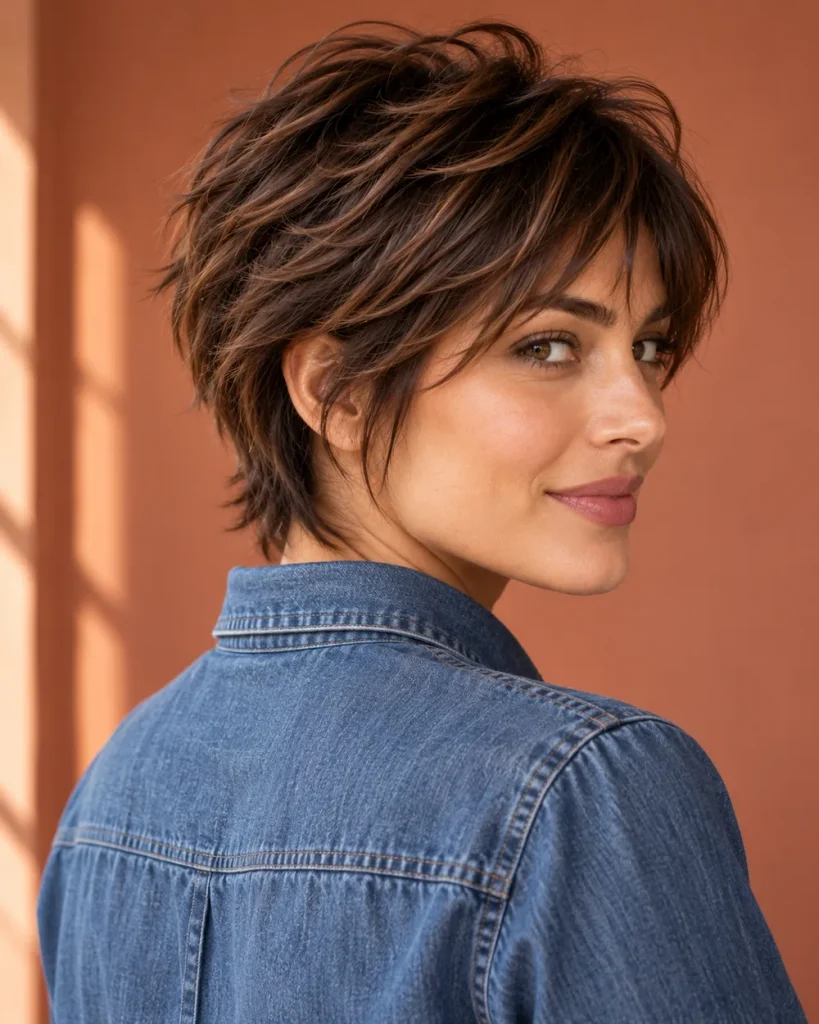
Most of the cut is a pixie shag, but the back keeps a soft tail of length at the nape instead of a tapered finish. That one detail changes the mood: the front reads neat and modern, the back reads a little rebellious. It also makes growing a pixie out far less awkward, because the in-between stage at the neck is already part of the design.
- Who it suits: Oval, round and heart faces. The nape length adds a vertical line, which round faces benefit from.
- Hair texture: Straight to wavy, medium to thick. Fine hair can wear it if the nape is kept wispy rather than chunky.
- Styling difficulty: Easy. Tousle the top, smooth the nape down with your palms, 3 minutes.
- Maintenance: Trim every 5 to 6 weeks, and decide at each appointment whether the nape stays or grows.
- What to ask your stylist: “A pixie shag with a longer, wispy nape, choppy layers on top, and a soft edge around the ears, nothing blunt at the back.”
Grow-out path: This is the easiest cut here for growing a pixie into a bob. The nape length becomes the back of the bob, and the top layers become its shag layers.
Shaggy Bobs, Jaw to Chin Length
Shaggy bobs are the middle ground of short shaggy haircuts: short enough to lift the hair off the neck and feel light, long enough to tuck behind the ears or part three different ways. If you have never worn your hair above the shoulders, start in this group.
Chin-Length Shag with Curtain Bangs

A chin-length bob cut like a shag, with layers through the back and ends and a curtain fringe that opens in the middle and melts into the sides. This is the version most people picture when they search short shaggy haircuts. It suits more face shapes and textures than any other cut here, it works in an office, and it still looks like a shag, not a bob with a few layers added.
- Who it suits: Almost everyone. Long faces gain width at the cheeks, square faces get softened corners, and round faces should ask for the length a fraction below the chin.
- Hair texture: Straight to wavy, fine to thick. Curly hair should look at the curly short shag with a rounded shape instead, which is this shape cut for curls.
- Styling difficulty: Easy. Air-dry with a scrunch for waves, or a quick rough blow-dry bending the ends out, 5 to 8 minutes.
- Maintenance: Trim every 6 to 8 weeks. The curtain fringe can go 8 weeks if you are happy for it to become face-framing layers.
- What to ask your stylist: “A chin-length shag with curtain bangs, layers through the back and ends, and the fringe blended into the sides, no blunt bob line.”
Wavy Shaggy Bob with Face-Framing Layers

Built around the pieces next to the face. The front layers start at the cheekbone and step down to the jaw, so the waves frame the face in a soft staircase instead of one heavy curtain of hair. The back is a simple layered bob. It is the most flattering option here for anyone who feels a one-length bob makes their face look wider.
- Who it suits: Round, square and heart faces especially. The cheek-level layers add structure to round faces and soften a square jaw.
- Hair texture: Wavy first, straight second (add a bend with a wand twice a week). Fine to thick densities all work.
- Styling difficulty: Easy. Scrunch and air-dry if you have waves; straight hair needs 5 minutes with a wand on the front pieces only.
- Maintenance: Trim every 6 to 8 weeks. Ask for the face-framing pieces to be refreshed even if you skip a full cut once.
- What to ask your stylist: “A wavy shaggy bob with face-framing layers starting at my cheekbones, choppy ends, and the shortest layer kept in front, not on top.”
Blunt-Ended Shaggy Bob for Thick Hair

A shag for people whose problem is too much hair, not too little. The internal layers are shaggy, which removes the heavy triangle shape thick bobs grow into, but the outer ends are left blunt and full, so the cut still looks thick rather than shredded. The layers do their work inside the shape, where nobody sees them.
- Who it suits: Oval, long and square faces. The full ends add width at the jaw, which balances a long face and a narrow chin.
- Hair texture: Thick, straight to wavy. The thick-hair answer among short shaggy haircuts if a pixie feels too exposed.
- Styling difficulty: Moderate. Thick hair takes longer to dry; rough-dry fully, then bend the ends, about 10 minutes. Air-drying works in summer.
- Maintenance: Trim every 6 to 8 weeks, with the internal layers rebalanced each time or the triangle shape returns.
- What to ask your stylist: “A shaggy bob with internal layers to remove the weight, blunt full ends, and no thinning at the outline, I want it to still look thick.”
Shags for Curly and Coily Hair
The rule with these two: the cut follows the texture you wake up with. Short shaggy haircuts fail when they are cut for one texture and styled against another every morning. If your hair is curly or coily, pick from this group and save yourself the daily argument.
Curly Short Shag with a Rounded Shape

The curly shag in its purest form: layers stacked so the whole shape rounds out, widest at the cheeks, with a curly fringe that sits on the forehead instead of being straightened into bangs. Volume is the point here, not a side effect. Cut dry and curl by curl, it grows out evenly for weeks, because every curl was placed at the length it actually lives at.
- Who it suits: Oval, long and heart faces. Long faces in particular gain the width they need at the cheek line. Very round faces should take the widest point a little higher, at the temples.
- Hair texture: Curly, types 3A to 3C, medium to thick. Fine curls can wear it with longer layers so the shape does not go see-through at the ends.
- Styling difficulty: Easy. Refresh with water and a little curl cream, scrunch and go, 3 to 5 minutes.
- Maintenance: Trim every 8 to 10 weeks. Curl hides regrowth, so this is one of the longest gaps between trims here.
- What to ask your stylist: “A curly short shag cut dry, curl by curl, rounded shape, layers stacked at the cheeks, and a curly fringe, no razor on my ends.”
Tip: Bring photo references with your own curl pattern, not a looser or tighter one. A 3A photo on 3C hair sets you both up to be disappointed.
Coily Shag with a Textured Fringe

Short shaggy haircuts are rarely shown on coily hair, which is a gap in most roundups. This shag is shaped for tight textures: the layers build a halo of volume around the head, and the fringe is a soft, textured edge rather than a defined bang. Cut mostly dry and picked out, it accounts for shrinkage honestly. It is a strong option if you want a short natural style that is neither a tapered cut nor a full afro shape.
- Who it suits: Oval, heart and long faces. The volume at the sides balances length in the face, and the fringe shortens a high forehead softly.
- Hair texture: Coily, types 4A to 4C, worn in its natural pattern. It also suits very tight curls that shrink to less than half their length.
- Styling difficulty: Moderate. Wash-day shaping takes time, but daily styling is a fluff and shape check, about 3 minutes.
- Maintenance: Trim every 8 to 12 weeks, mainly to keep the ends healthy and the fringe out of the eyes.
- What to ask your stylist: “A coily shag cut dry in its natural pattern, layers for a rounded shape with a soft textured fringe, and please account for my shrinkage.”
Age-Smart and Statement Shags
The last group answers specific requests: gray hair that needs a modern shape, a fringe chosen for one face shape, and the boldest cut on the list. These are the short shaggy haircuts people book after a basic bob or pixie has stopped feeling like them.
Silver Short Shag for Women Over 60

Gray hair often grows in with a different texture than the hair it replaced: wirier, drier and more stubborn. A soft shag is one of the kindest shapes for that change, because the layers give wiry hair direction, the broken ends hide the texture change, and nothing about the cut needs dye or heat to look finished. Keep the fringe long and side-swept and the edges soft, and silver hair reads bright and deliberate.
- Who it suits: Oval, heart and square faces. It works well with glasses, because a side-swept fringe does not fight with frames the way a straight bang can.
- Hair texture: Straight to wavy gray and white hair, fine to thick. Very coarse, wiry hair should ask for point-cutting and skip the razor.
- Styling difficulty: Easy. A little smoothing cream on damp hair and fingers to place the fringe, 3 to 5 minutes.
- Maintenance: Trim every 6 to 8 weeks. The tidy schedule is part of what keeps gray hair looking polished.
- What to ask your stylist: “A silver short shag with soft point-cut layers, a long side-swept fringe that works with my glasses, and no blunt lines anywhere.”
Tip: If your gray turns yellow between cuts, heat, sun or product buildup is the usual cause, not the cut. A clarifying wash once a month and lower dryer heat fix most of it.
Short Shag with Bottleneck Bangs for Round Faces

Bottleneck bangs are narrow at the top, like the neck of a bottle, then widen and curve out at the cheekbones. On a round face they do two useful things at once: the narrow top keeps the forehead from looking wider, and the curved sides draw a vertical line down the face. Paired with an ear-to-jaw shag that keeps its volume on top, this is the most deliberately flattering cut here for round faces.
- Who it suits: Round faces first, by design. It also suits oval faces and anyone who found curtain bangs too wide and heavy.
- Hair texture: Straight to wavy, fine to medium. Thick hair can wear it if the fringe is point-cut so it does not sit like a shelf.
- Styling difficulty: Easy to moderate. The fringe is the work: 2 minutes to dry it forward, then let it fall open. The rest is a tousle.
- Maintenance: Fringe trim every 4 to 5 weeks, full cut every 6 to 8 weeks. Bottleneck bangs lose their shape faster than curtain bangs.
- What to ask your stylist: “A short shag with bottleneck bangs, narrow at the top and curving out at my cheekbones, volume on top, sides kept slim.”
Short Wolf Shag with a Longer Back

The boldest of these short shaggy haircuts, borrowing from the wolf cut: heavy, choppy layers on top, thinner, wispier ends, and a back that keeps real length while the sides stay short. The contrast is the whole point. It is also, honestly, the cut that grows out worst if you skip trims, because the thin ends and the long back drift apart.
- Who it suits: Oval and heart faces, and strong features that can hold a strong cut. Round faces should keep the back shorter and the top higher.
- Hair texture: Straight to wavy, medium to thick. Fine hair struggles here; the wispy ends can look sparse instead of edgy.
- Styling difficulty: Moderate. It needs deliberate messing up each morning, 5 minutes with a texturizing product worked through the top layers.
- Maintenance: Trim every 5 to 6 weeks if you want the contrast to stay clean.
- What to ask your stylist: “A short wolf shag, heavy choppy layers on top, wispy ends, sides short and the back kept longer, with a clear difference between them.”
Grow-out path: If you tire of it, the route back is a shaggy bob. Your stylist evens the back up to the sides over two cuts, and the top layers become bob layers.
Quick Comparison: Short Shag Shapes Side by Side
This table sums up the short shaggy haircuts above by shape, so you can match the length to your trim habits before you book.
| Shape | Length | Best texture | Trim every | Morning styling |
|---|---|---|---|---|
| Pixie shag | 2 to 4 inches on top, close sides | Straight to wavy | 4 to 6 weeks | 2 to 5 minutes |
| Shaggy bob | Jaw to chin | Straight to wavy, fine to thick | 6 to 8 weeks | 5 to 10 minutes |
| Curly or coily shag | Ear to jaw | Curly to coily | 8 to 12 weeks | 3 to 5 minutes |
| Wolf shag | Short sides, longer back | Straight to wavy, medium to thick | 5 to 6 weeks | About 5 minutes |
Mistakes to Avoid with a Short Shag
Asking for layers without saying where. “Lots of layers” can mean crown layers, internal layers or face-framing layers, and they do opposite jobs. Crown layers add height, internal layers remove bulk, face layers shape the front. Use the ask-your-stylist line for your cut word for word; it names the layer placement for you.
Copying a photo with a different texture. A wavy shag photo taken on straight hair with a wand will not survive your first wash, and a curly shag cut from a straight-hair reference will spring up inches shorter. Match the reference photo to your hair on a normal day, not its best day.
Razor cutting curly, coily or damaged hair. A razor gives straight hair wispy ends and gives curls frayed ones. If your texture is curly or coily, or your ends are already fragile, ask for scissor or point cutting only. The American Academy of Dermatology’s healthy hair tips make the wider point: how hair is handled and styled decides a lot of breakage.
Skipping trims because the cut looks messy anyway. The messy finish hides a week or two of growth, not two months. The fringe reaches your eyes, the nape loses its line, and the crown layers fall flat, in that order. Book the next trim before you leave the salon.
Over-thinning fine hair. Fine hair in a shag needs point-cut texture, not removed bulk. Thinning shears through the ends of fine hair make the last inch transparent. The soft pixie shag for fine hair is built around avoiding this; show it to your stylist if fine hair is yours.
Frequently Asked Questions
Do short shaggy haircuts work for fine hair?
Yes, with the right version. Fine hair needs long layers, fuller ends and no thinning shears near the tips, which is exactly how the soft pixie shag for fine hair is cut. Volume should be built at the root, not removed from the ends.
How often do short shaggy haircuts need a trim?
Most need a tidy-up every 5 to 7 weeks. Pixie shags and fringes sit at the fast end, every 4 to 6 weeks, and curly and coily shags at the slow end, every 8 to 12 weeks, because curl hides the growth. Regular trims keep the shape; they do not make hair grow faster.
Will a short shag work on curly or coily hair?
Yes, and arguably short shaggy haircuts work best there, because curls supply the texture the cut is built around. The conditions are a dry cut, curl by curl, layers placed for a rounded shape and no razor on the ends.
What is the difference between a shag and a wolf cut?
Length contrast. A shag layers the hair fairly evenly, so top, sides and back sit in one family of lengths. A wolf cut pushes the contrast: much shorter, heavier layers on top and longer, thinner hair at the back. A short wolf shag is the halfway house for people who want the contrast without growing the back out long.
Can I wear a short shag after 50 or 60?
Plenty of women do, and the shag has two real advantages at that age: the soft layers are kind to changing hair texture, and the fringe options soften the forehead without a heavy straight bang. Keep the edges soft and keep to the trim schedule.
How do I choose between a shag and other short cuts?
Decide how much texture you want to see first. A classic bob is one clean line, a pixie is close and neat, and a shag is layers and movement everywhere. Pick the length you like, then choose the shag version of that length.
Final Thoughts
The best short shaggy haircuts are not the boldest ones on the page. They are the ones matched to your texture, your face and the trim schedule you will actually keep. A shaggy bob you maintain will look better in month three than a wolf shag you abandon, every time.
Pick your top two, check their maintenance lines against your real salon habits, and take the photos plus the ask-your-stylist lines to your appointment. The right shape plus the exact words is how short shaggy haircuts come out of the salon looking like the picture you saved.