
How to Find Your Face Shape in 4 Simple Measurements
Most haircut advice starts with one question: what shape is your face? Most people answer it by squinting at a selfie, and that is where the trouble begins. Phone cameras held close stretch the middle of the face and shrink the sides, lighting hides the jawline, and a good hair day changes the outline completely.
A soft tape gives you a much better way to find your face shape. Four quick measurements, written side by side, show a pattern, and that pattern points to round, oval, square or heart-shaped. It takes about ten minutes, you already own everything you need, and the result makes every haircut guide easier to use, because you will know which advice was written for you.
This guide walks you through each measurement, shows you how to read the numbers with real examples, and explains what to do if your face sits between two shapes.
Quick answer: To find your face shape, pull your hair back and measure four things with a soft tape: face length, forehead, cheekbones and jaw. If length and cheekbone width are almost equal and the jaw is soft, your face is round. If length is clearly the largest number, it is oval. If the three widths match and the jaw has corners, it is square. If the forehead is widest and the jaw is narrowest, it is heart-shaped.
What You Need
You do not need anything special to find your face shape. A soft sewing tape is ideal. If you do not have one, use a piece of string or ribbon and lay it against a ruler afterward. You will also want a hair tie or a couple of clips, a pen and paper or your phone notes, and good, even light in front of you rather than overhead.
A mirror helps you see where the tape sits. Measuring is easier if someone else holds the tape, but you can do it alone.
Before You Start
Get every strand off your face. Pull your hair back from the forehead, ears and jaw into a smooth, loose tie. Loose hair at the sides adds width that is not part of your face, and that alone can turn an oval reading into a round one.
Relax your face. Keep your mouth closed and your teeth apart, and look straight ahead. Smiling lifts the cheeks, and clenching widens the jaw.
Keep the tape flat. It should touch the skin all the way along without pressing in. A tape pulled tight reads small; a slack one reads large.
Measure each line twice. If the two readings differ, take a third and keep the middle one. Write every number down as you go, in the same unit throughout.
The Four Measurements
You find your face shape from how the four numbers compare, not from any one of them on its own. Take all four, even if the first seems to give the answer away.
Measure Your Face Length

Start at the center of your hairline and run the tape straight down the middle of your face to the bottom of your chin. Let it pass lightly over the tip of your nose without pushing it in.
If your hairline is hard to place, because of a widow’s peak, very fine baby hairs or a receding hairline, start where the first full row of hair begins at the center. This is usually your largest number, and the other three are compared with it.
Measure Your Forehead
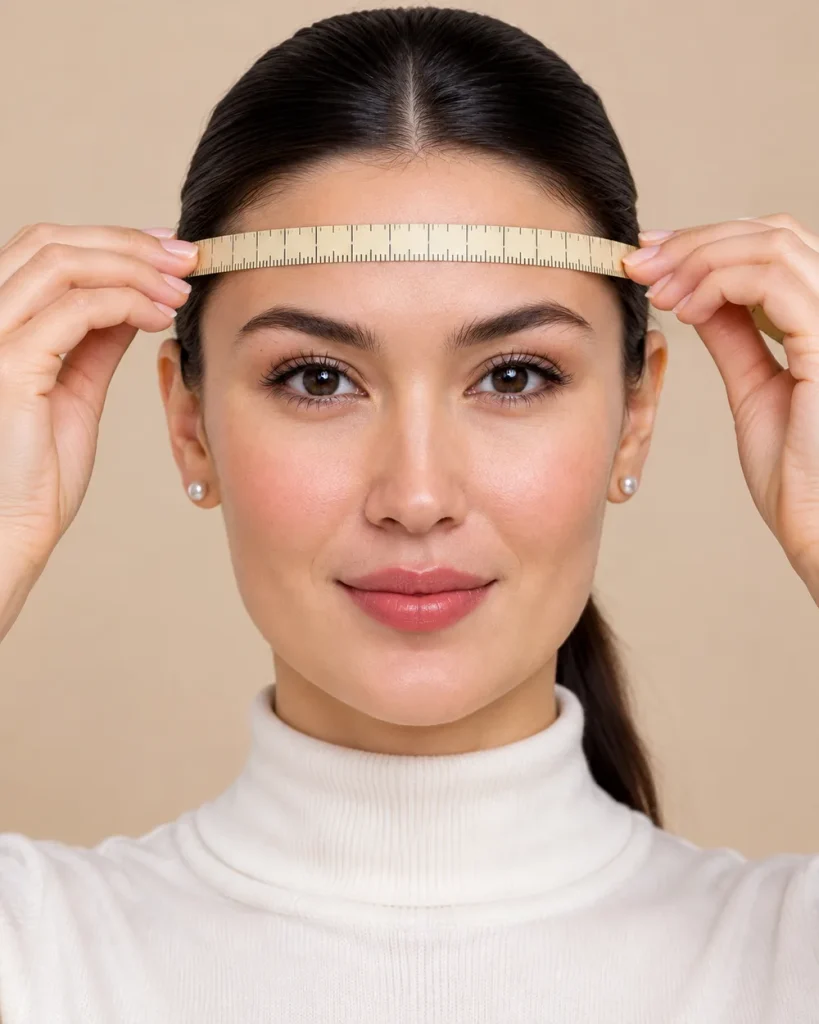
Find the widest part of your forehead, usually about halfway between your eyebrows and your hairline. Measure straight across from the point where the forehead starts to curve back on one side to the same point on the other.
Keep the tape level. If it slips down toward the temples, the number will drop and your face can look more heart-shaped than it really is.
Measure Your Cheekbones
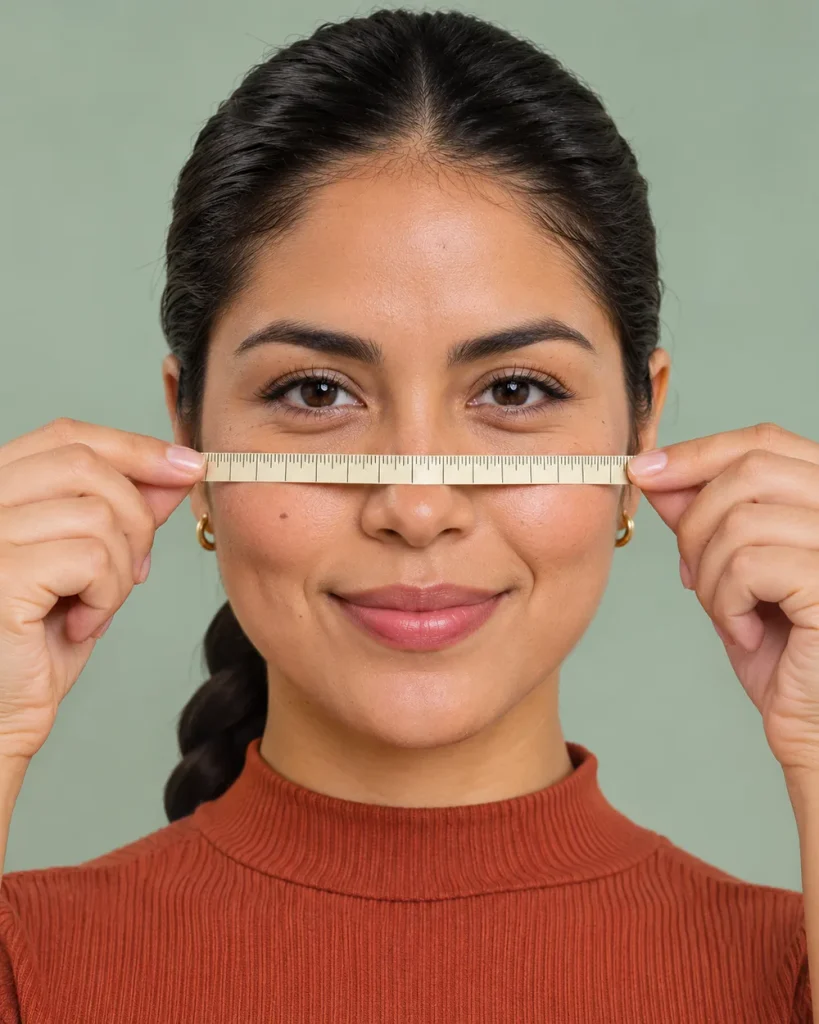
Feel for your cheekbones first: they are the firm points just below the outer corners of your eyes. Run the tape from one point to the other, straight across, passing just below the eyes and lightly over the bridge of the nose.
For most people this is the widest of the three width measurements, and how it compares with your face length is one of the clearest clues in the whole test.
Measure Your Jaw
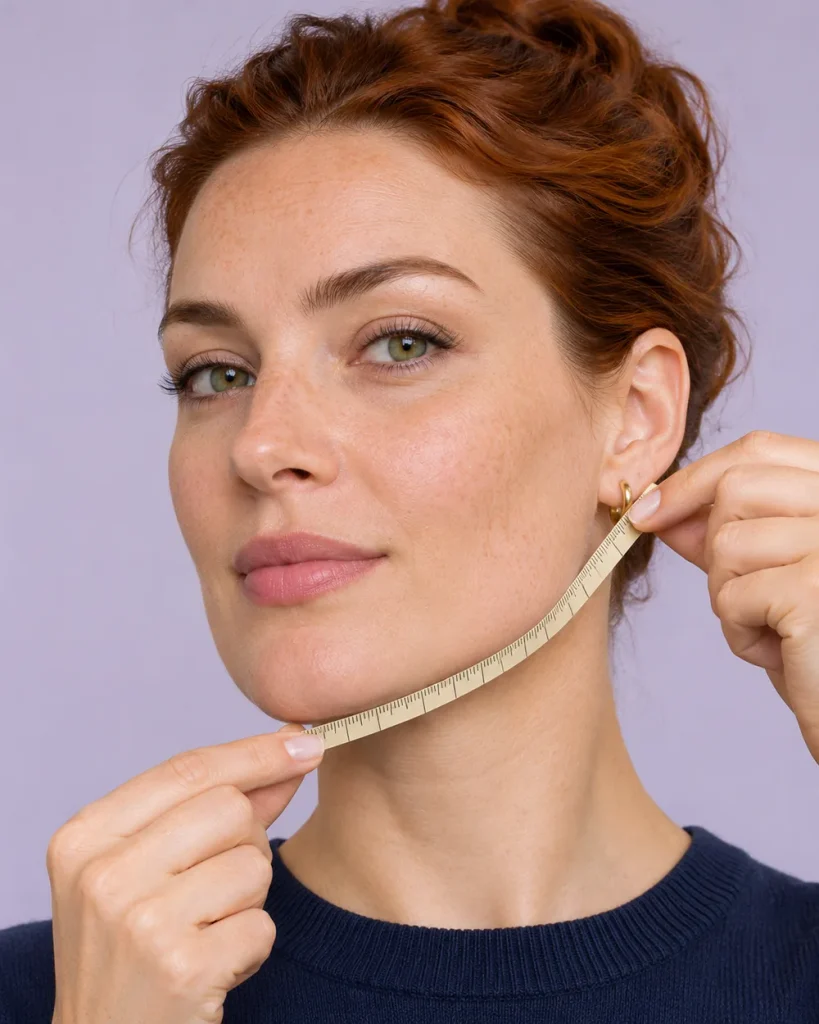
Place the end of the tape at the corner of your jaw just below the earlobe, where the jaw turns upward. Run it along the jawline to the center of your chin, then double that number. Measuring one side and doubling it is far easier than wrapping a tape under the chin.
While you are there, notice how the jaw feels. A jaw that turns in a firm corner and a jaw that curves smoothly can give the same number but belong to different shapes. That feel matters later.
How to Read Your Numbers
This is the step where you actually find your face shape. Lay your four numbers out in a row: length, forehead, cheekbones, jaw. Then ask three questions.
Is the length much bigger than the cheekbones? Divide your face length by your cheekbone width. A result close to 1, roughly up to 1.25, means the face is about as wide as it is long, which points to round or square. A result of about 1.3 or more means the face is clearly longer than it is wide, which points to oval or, if the forehead leads, heart.
Which width is the largest? If the forehead is clearly the widest and the jaw is clearly the narrowest, that is the heart pattern. If the three widths are within about 1 cm (half an inch) of each other, the face is either round or square.
Does the jaw have corners? This settles the round-versus-square question. A curved jaw with a soft, rounded chin is round. A defined angle below each ear and a flatter chin is square.
Here is what the patterns look like with real numbers:
| Face shape | Length | Forehead | Cheekbones | Jaw (doubled) | What gives it away |
|---|---|---|---|---|---|
| Round | 18 cm (7.1 in) | 13 cm (5.1 in) | 15 cm (5.9 in) | 12 cm (4.7 in) | Length only a little more than cheekbones, soft curved jaw |
| Oval | 20 cm (7.9 in) | 13 cm (5.1 in) | 14 cm (5.5 in) | 11.5 cm (4.5 in) | Length clearly the biggest number, widths step down gently |
| Square | 18 cm (7.1 in) | 14 cm (5.5 in) | 14.5 cm (5.7 in) | 14 cm (5.5 in) | Three widths almost equal, jaw with clear corners |
| Heart | 19 cm (7.5 in) | 15 cm (5.9 in) | 14 cm (5.5 in) | 11 cm (4.3 in) | Forehead widest, jaw clearly narrowest |
Your own numbers will not match exactly, and they do not need to. What matters is the relationship between them. Note that the jaw figure is the doubled half measurement, so it can look small next to the other widths; compare it with the forehead rather than with the length.
The Four Face Shapes
Once you have the pattern, use the features below to confirm it. When the numbers and the mirror agree, you can trust the result. If you find your face shape fits two of these sections, the in-between section below will help.
Round Face
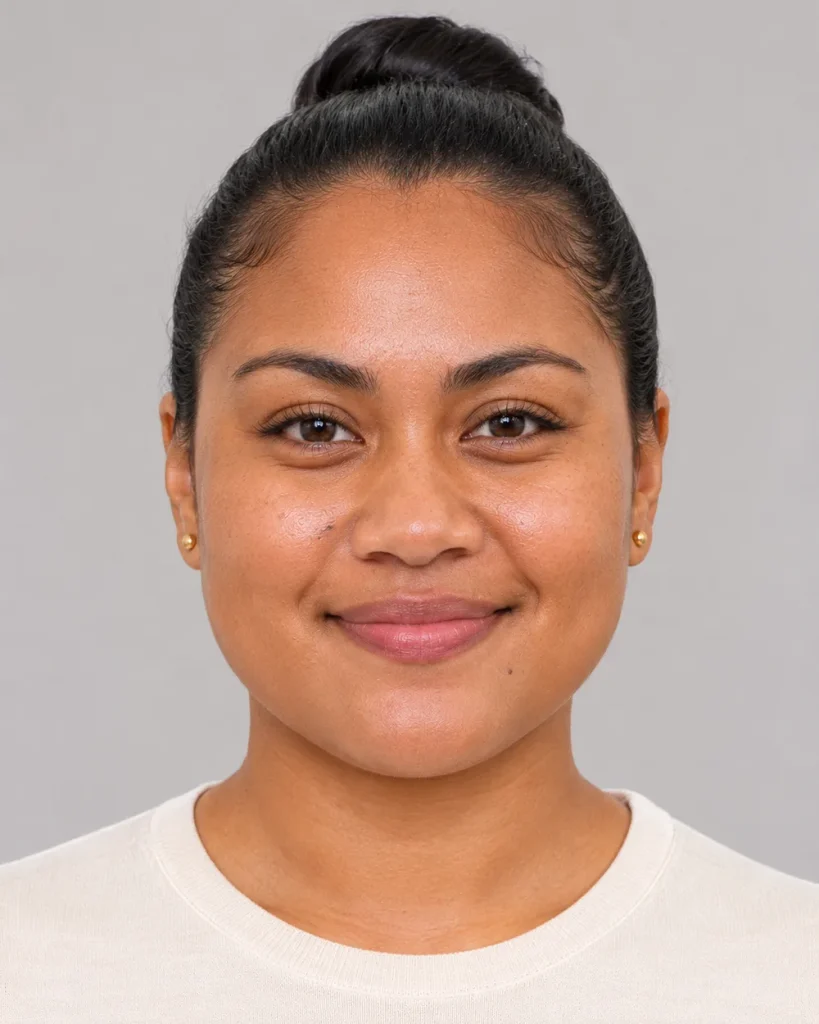
The numbers: face length only a little more than the cheekbone width, the cheekbones the widest point, and the forehead and jaw slightly narrower and close to each other.
What you see: full cheeks, a rounded chin and a jaw that curves smoothly with no visible corner. The face looks almost as wide as it is long, and round faces often look younger than they are.
What usually suits it: cuts that add height at the crown and end below the chin, with no extra width at cheek level. Our guide to haircuts for round faces covers 25 options, from short angled bobs to long layers.
Oval Face

The numbers: face length clearly larger than the cheekbone width, often by a third or more. The forehead is a little wider than the jaw, and both are slightly narrower than the cheekbones, so the widths taper gently in both directions.
What you see: a balanced face that is longer than it is wide without looking narrow, with a gently rounded jaw and chin.
What usually suits it: almost any cut, so let your hair texture and the time you want to spend styling decide. If you have been wanting to go short, an oval face is the easiest place to try it, and our guide to short hairstyles for women is a good place to start.
Square Face
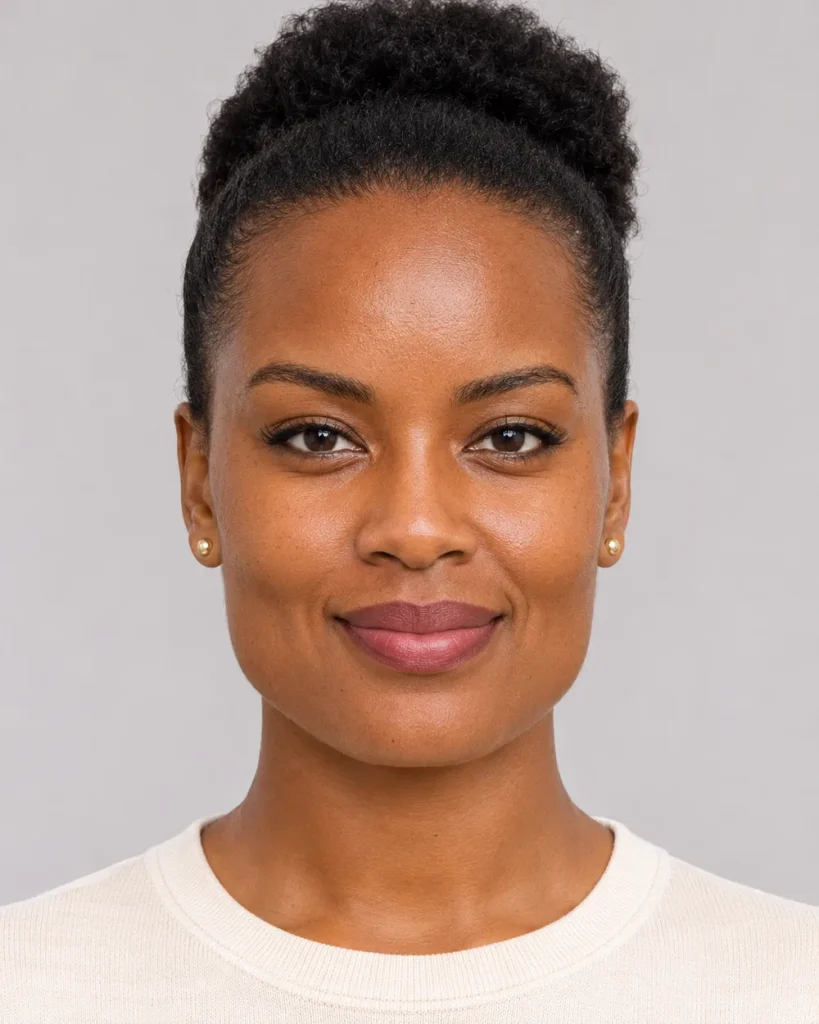
The numbers: forehead, cheekbones and jaw all within about 1 cm (half an inch) of each other, with face length only a little greater than those widths.
What you see: a broad, fairly straight forehead, sides that run down in a nearly straight line and a defined jaw that turns at a clear corner below each ear. The chin is usually flat rather than pointed.
What usually suits it: softness around the jaw corners, from layers, waves and side parts, unless you want to show off a strong jaw, which many square faces carry beautifully. Soft movement around the face is often the easiest win, and our guide to long layered haircuts shows plenty of ways to add it.
Heart-Shaped Face

The numbers: the widths step down from top to bottom. The forehead is the widest, the cheekbones come next and the jaw is clearly the narrowest, often by 2 cm (about an inch) or more compared with the forehead.
What you see: a broad upper face, sometimes with a widow’s peak, cheeks that taper quickly below the cheekbones and a fine, often slightly pointed chin.
What usually suits it: fullness around the jaw and chin and less volume on top. Chin-length and shoulder-length cuts, side parts and fringes that break up the forehead all help balance the two halves.
When Your Face Is Between Two Shapes
Plenty of faces do not fit neatly into one box. If you find your face shape sits between two patterns, that does not mean you measured wrong. Some faces are long like an oval but have a firm jaw like a square. Others have a round face’s balanced numbers but a forehead that clearly leads, like a heart.
Go with the closest match. Look at which pattern your numbers lean toward and start with that shape’s advice. Then borrow a tip or two from your second shape. For example, a face between round and oval can wear most oval cuts and still follow the round-face rule of keeping width away from the cheeks.
If you are genuinely stuck, let your jaw and chin decide, because they break more ties than any number:
- Soft, curved jaw and rounded chin: lean round or oval
- Jaw with clear corners and a flat chin: lean square
- Narrow jaw with a fine or pointed chin: lean heart
If you would like a second way to check, this guide on how to determine your face shape shows a method that needs no tape: tracing the outline of your face on a printed photo, along with styling tips from a celebrity hairstylist.
Your Numbers Help With Glasses Too
Once you find your face shape, the same four numbers make frame shopping easier, because glasses tend to flatter when they contrast with the face. Angular frames give a round face definition, rounded frames soften a square jaw, and frames a little wider than the forehead keep a heart-shaped face balanced. Your cheekbone width is also a useful guide to how wide a frame should be.
Mistakes to Avoid
A few small slips make it much harder to find your face shape accurately.
Measuring over loose hair. Even a low ponytail can leave hair at the jaw and cheeks. Pull everything back smoothly before you pick up the tape.
Pulling the tape tight. A tape pressed into the skin gives small numbers, and the error shows most at the cheekbones and jaw, which are exactly the numbers you need to compare.
Using a selfie instead of a tape. A front camera held close widens the middle of the face, and a smile changes the cheeks. A straight-on photo taken from arm’s length or further is a useful check on the shape of your jaw and chin, but it cannot replace the numbers.
Taking only the length. One number cannot make a pattern. A long face can be oval, square or heart-shaped depending on the widths, and a short face is not automatically round.
Forcing a perfect match. If your numbers land between two shapes, accept the closest match instead of measuring again and again until they fit a box.
Frequently Asked Questions
What is the easiest way to find your face shape?
Pull your hair back, measure your face length, forehead, cheekbones and jaw with a soft tape, and compare the four numbers. Then check the jaw and chin in the mirror to confirm.
Can my face shape change?
Your bone structure stays the same, but weight changes can shift how your face reads. Fuller cheeks can move an oval reading toward round, and weight loss can make a jaw look more defined. If your weight has changed a lot, it is worth taking ten minutes to find your face shape again before a big haircut.
Is it better to use a photo or a tape?
A tape. Photos depend on the lens, the distance and the light, while the tape measures the real proportions. A straight-on photo is useful only as a second check.
What is the most common face shape?
Oval is often described as the most common, but many people are a mix of two shapes. Your own numbers matter far more than averages.
Do men find their face shape the same way?
Yes. The four measurements and the patterns are exactly the same. Men’s readings often show a stronger jaw, so square patterns come up more often.
What if my face does not match any of the four shapes?
Choose the closest one. Some guides add shapes such as diamond or oblong, but nearly every face leans toward one of these four, and that is enough to choose a flattering haircut.
Final Thoughts
Once you find your face shape, you stop guessing in the salon chair. Four numbers, one pattern and a quick look at your jaw and chin are all it takes, and if you land between two shapes, the closest match works perfectly well. Save your numbers in your phone, start with the shape section that matches them, and use that shape’s haircut guide to narrow down your next cut.