

How to Trim Your Bangs at Home Without Ruining Them
Bangs always need attention before the rest of your hair does. Around three weeks after a salon cut, your fringe starts poking your eyes while everything else still looks fresh. Learning how to trim your bangs at home solves that gap: a five-minute tidy-up instead of an extra appointment every month.
This guide covers that small maintenance trim only. It is not a guide to cutting a brand-new fringe or changing your bang style, because those jobs need a stylist. What it will teach you is the careful, dry method that stylists themselves recommend, so you take off just enough and nothing more.
The good news is that a bad home trim is rarely about skill. It almost always comes from three habits: cutting wet hair, pulling the fringe down tight and taking everything off in one go. Avoid those, and you can trim your bangs safely between visits.
Quick answer: Work on clean, dry bangs styled the way you wear them. Clip back everything except the fringe, then take off no more than half a centimeter at a time using tiny upward snips. Comb, let it settle and check after every pass. Stop while it still looks a little long.
What You Need
You only need five things to trim your bangs at home, and the most important one is a pair of proper hair scissors. Lay everything out before you start, so you are not hunting for a clip halfway through.
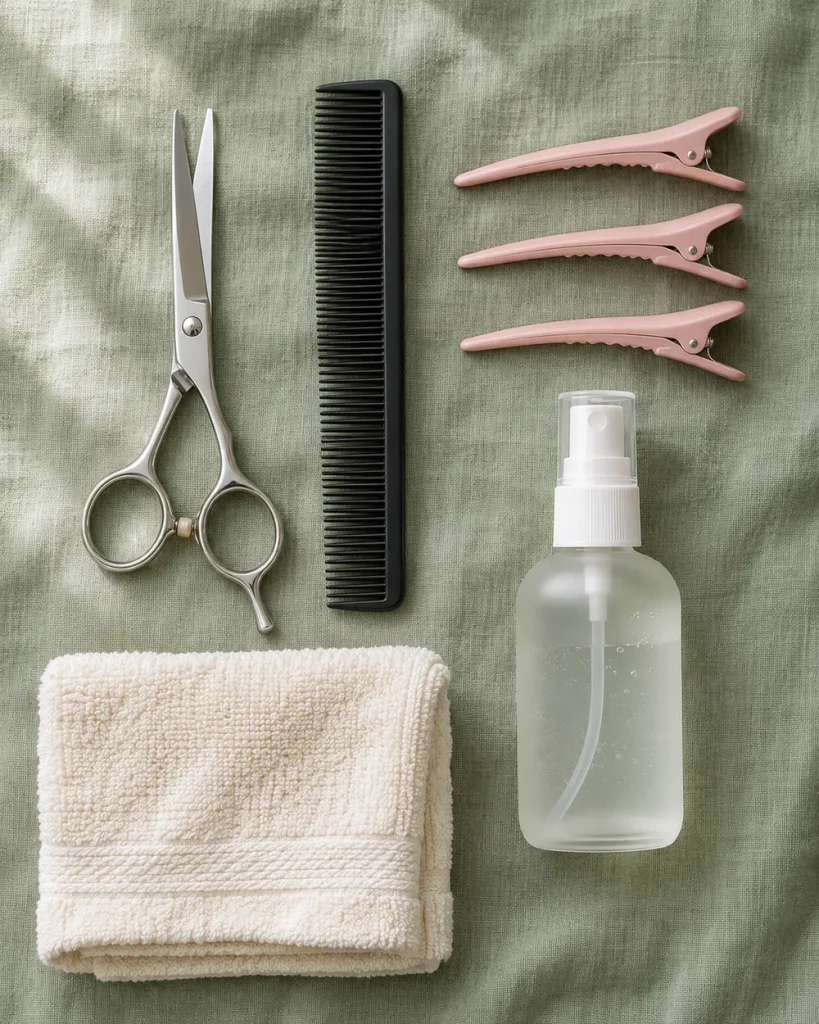
| Tool | What it does | What to look for |
|---|---|---|
| Hair-cutting scissors | The actual trim | Small, sharp shears made for hair. Never craft, paper or kitchen scissors. |
| Fine-tooth comb | Combing the fringe flat between passes | Narrow teeth that glide through small sections |
| Sectioning clips | Holding the rest of your hair back | Two to four clips, enough to keep all side hair off your face |
| Spray bottle | Taming a cowlick or a bent section | A fine mist, not a soak; the hair should be dry again in a minute |
| Bright light | Checking the length honestly | Daylight from a window or a bright bathroom light at face height |
Household scissors are the hidden cause of many bad trims. Their blades are thicker and duller, so they fold and crush each strand instead of slicing it, and the ends fray and split within weeks. Healthline’s guide to preventing split ends explains why clean, sharp cuts matter for healthy ends. To test your scissors, try snipping a single hair: a sharp pair cuts it cleanly, while a dull pair bends it first.
When Not to Do It Yourself
A home trim is only for keeping a fringe you already have. Book your stylist instead if:
- It would be your first fringe. Deciding where bangs start, how thick they are and how they suit your face is a skilled job, and mistakes cannot be swept aside.
- You want a different style. Turning wispy bangs into a blunt fringe, or blunt bangs into curtain bangs, is a restyle, not a trim.
- You need more than a centimeter off. Big length changes are where home trims go wrong.
- Your bangs are very curly and you have never cut them. Curls shrink by different amounts and need to be cut curl by curl. Ask your stylist to show you the pattern first.
If you are still choosing a fringe, our guide to long hairstyles with bangs shows the main styles so you can take a photo to your appointment.
Four Rules Before You Pick Up the Scissors
These four rules matter more than any single step. Every good way to trim your bangs at home is built on them.
Cut dry. Wet hair stretches and hangs lower than dry hair. When it dries, it springs up, so bangs cut wet almost always end up shorter than you planned.
Take less than you think. Whatever you believe needs to come off, take half of it first. A fringe that is still a little long is a two-minute fix tomorrow. A fringe that is too short is a month of waiting.
Snip into the ends instead of cutting straight across. Hold the scissors pointing up into the hair and make tiny snips. This is called point cutting. It removes length gently and leaves a soft edge, while one straight cut leaves a hard line that shows every wobble.
Never pull the fringe down tight. Hair held under tension jumps back up when you let go. Let your fingers rest lightly under the hair at the length you want, without dragging it down.
How to Trim Your Bangs Step by Step
Give yourself 20 minutes, most of it for washing and drying. The cutting itself takes about five.
Start With Clean, Dry Bangs
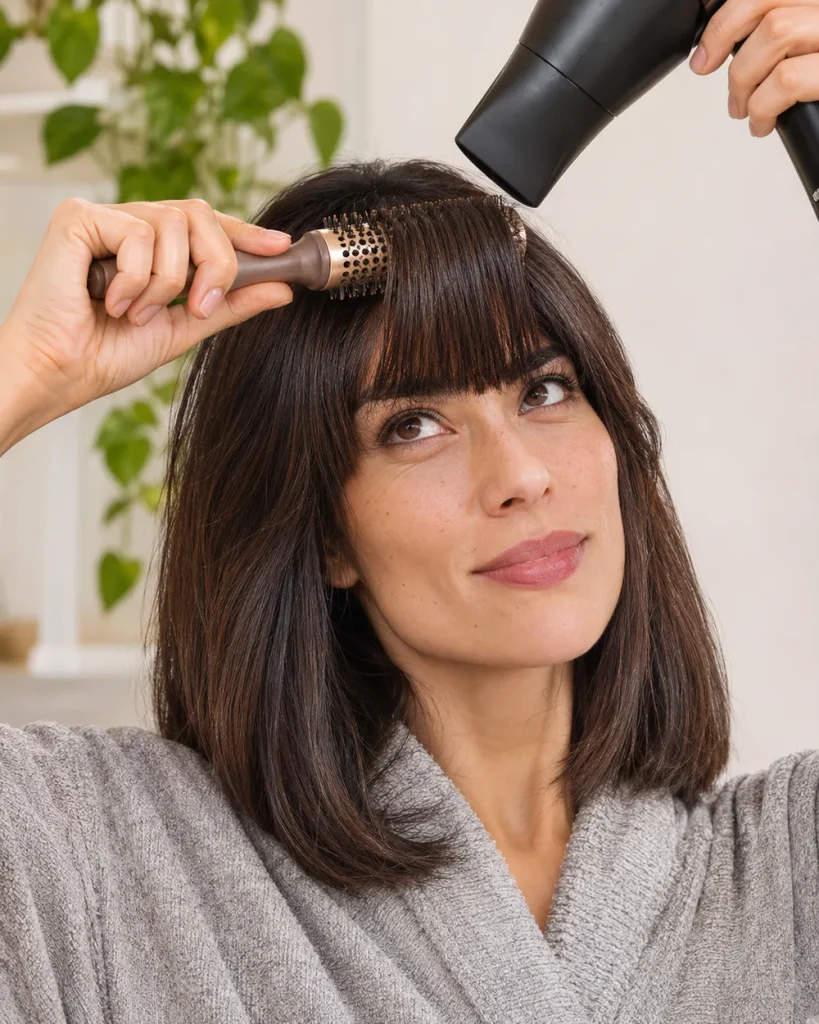
Oily bangs clump together and hang lower and straighter than clean ones, which makes every cut misleading. Wash your hair, or just wash the fringe at the sink, then dry it completely and style it exactly the way you wear it.
Blow-dry curtain bangs from above so they settle into their part. Dry blunt bangs flat against the forehead. Let wispy bangs fall naturally. Never trim your bangs straight after taking out a ponytail or headband, because the bends from those hide the true length.
Section the Fringe
Every fringe grows from a small triangle at the front of the head. Use your comb to find it: the back point of the triangle sits about two to three centimeters behind your hairline, and the two front corners end roughly above the outer edge of each eyebrow. Comb only that hair forward over your face.
This step matters more than it looks. Pulling extra side hair into the fringe is how a quick tidy-up turns into a new, heavier fringe. If you are unsure where the triangle ends, take less hair rather than more.
Clip Everything Else Back
Pin all other hair up and away, including the long face-framing pieces at the sides. Loose strands drift forward mid-cut and get snipped by accident, and one cut layer can take months to grow back. Before you pick up the scissors, check from both sides that the fringe is the only hair in front of your face.
Comb and Let It Settle
Comb the fringe down or into its usual part, then tap it lightly with your fingertips and wait a few seconds. Freshly combed hair sits tighter and lower than hair at rest, so cutting immediately takes off more than you see.
Repeat this comb, wait and look routine before every single pass. The fringe shifts a little each time you touch it, so the length you checked a minute ago is not quite the length in front of you now.
Make the First Pass Long
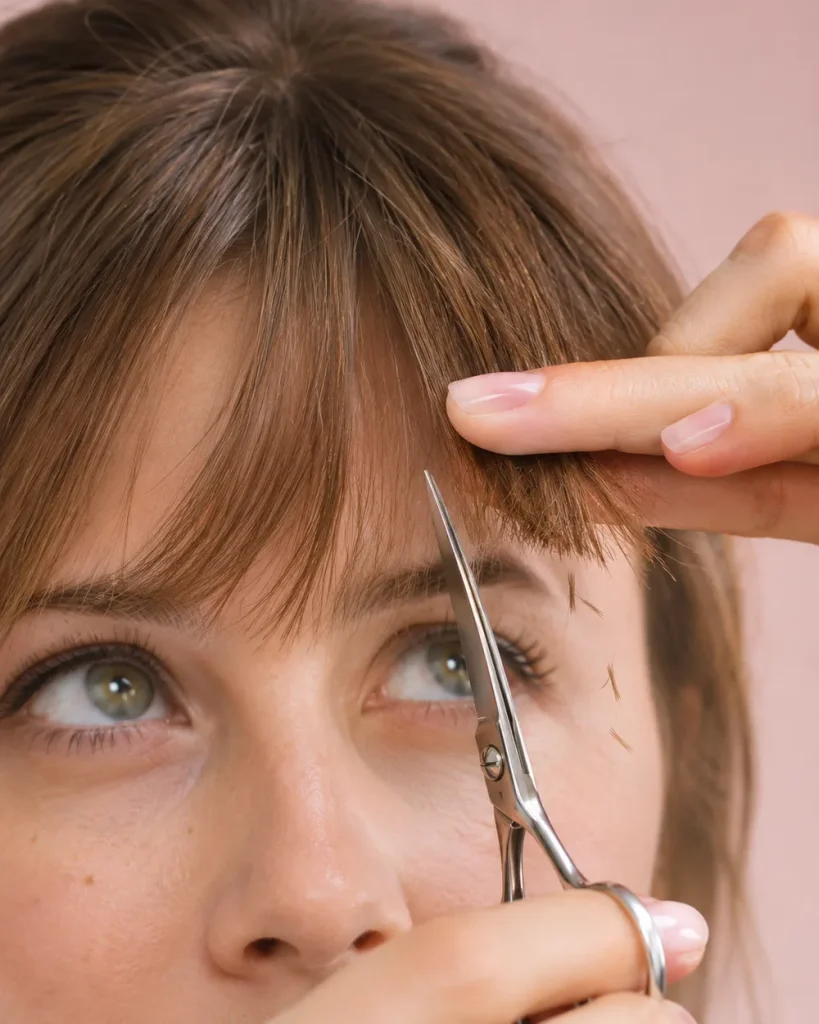
Hold a small section between two fingers at the length you want to keep, with no downward pull. With your other hand, point cut the ends below your fingers: scissors angled upward, tiny snips of a millimeter or two, working slowly from one side to the other.
Take half a centimeter at most, even if you are sure more needs to go. Then comb, settle and look. Very often the fringe already looks right, because the few longest, uneven ends were causing most of the problem.
Refine the Ends
Now work in small sections again, taking just a millimeter or two each time and following the shape your stylist created: straight across for blunt bangs, curving longer at the sides for curtain bangs and on a diagonal for side-swept bangs.
When you trim your bangs this slowly, the aim is a soft, even edge, not more length. Keep the snips shallow, as deep vertical cuts leave notches. Comb and settle after every section before you judge it.
Check Both Sides and Stop

Put the scissors down for a minute. Step back in bright light and look at the fringe as a whole. Check two things: that the lowest point over each eye matches, and how the fringe sits after it moves. Lift it gently with your fingers and let it fall, because hair sits slightly shorter once it has been moved.
If one side is longer, take two or three snips from that side only, then check again. Style the fringe exactly as you wear it for a final look. If it still seems half a centimeter long, stop anyway. That is exactly the right place to finish.
How to Trim Different Types of Bangs
The method stays the same, but each style needs one or two small adjustments.
Curtain Bangs

Curtain bangs are the easiest style if you want to trim your bangs at home, because their longest pieces sit near the cheekbones, where a millimeter either way does not show. Trim only the center pieces that fall into your eyes, and leave the long outer corners alone, as cutting them shortens the whole frame around your face.
Keep your center part in place while you cut and work on one side of it at a time, so both sides match. Curtain bangs are usually worn with soft layers behind them; our guide to long layered haircuts shows how the fringe and layers should blend.
Blunt Bangs

A blunt fringe shows every mistake, so it needs the slowest version of this method. Resist the urge to make one straight cut across: on dry hair, a single straight line almost always looks uneven once the hair relaxes, and the only fix is going shorter.
Work in three sections instead, the center first and then each side, using tiny point cuts. Keep the line at or just below your eyebrows. Blunt bangs are often paired with a bob, and our guide to bob haircuts for thin hair explains how a fringe changes the balance of a shorter cut.
Side-Swept Bangs

Always trim side-swept bangs in the direction you wear them, never combed straight down. Sweep the fringe across your forehead, let it settle and point cut along the natural diagonal, taking a little more from the longest corner.
If you cut them straight down first and sweep them afterwards, the result is shorter than expected, because hair lying on a diagonal covers more distance. Check the final shape with your head upright, not tilted toward the light.
Wispy Bangs

Wispy bangs need the lightest touch of all, because there is so little hair that half a centimeter can make the fringe look half gone. Point cut only the few longest strands and leave the shorter pieces alone, so the soft, see-through look stays intact.
If your wispy fringe looks messy, try washing it before you trim your bangs at all. Fine fringe hair gets oily faster than any other part of your hair, and a quick wash often fixes the problem without scissors.
How to Fix Common Mistakes
Bangs Too Short
Stop cutting straight away, as every extra snip makes it worse. Bangs grow roughly a centimeter a month, so a too-short fringe usually looks fine again in three to four weeks. Meanwhile, blow-dry it flat against your forehead to use every bit of length, sweep it slightly to one side if your style allows and do not trim the sides to match.
Bangs Uneven
This is the most common result of a home trim, and the fix is patience. Comb, settle and find the single longest point. Take one or two tiny snips from that point only, then comb and settle again. Never try to even things out by cutting the shorter side, and never make more than two snips without checking, because that is how uneven bangs become short bangs.
Bangs Too Thick
If your fringe feels heavy, do not try to thin it at home by cutting up into it. Home thinning leaves frizzy short pieces and a fringe that separates oddly as it grows. Removing bulk is a stylist’s job, because it is done from inside the section where you cannot see. Trim your bangs for length at home and ask for thinning at your next salon visit.
Mistakes to Avoid
Trimming wet hair. Wet bangs hang low, then dry and spring up shorter than planned. Always trim dry and styled.
Using the wrong scissors. Kitchen and craft scissors crush the hair and leave frayed ends. A small pair of real hair scissors costs little and lasts for years.
Pulling the fringe down. Tension adds invisible length that disappears the moment you let go. Let your fingers rest; do not drag.
Cutting the final length in one go. Reach the length in small passes with checks in between. The first pass should be half of what you think you need.
Trimming in poor light. Steam, dim bulbs and a foggy bathroom hide uneven spots. Use the brightest light you have and do a final check near a window.
Trimming too often. Small trims every few days add up quickly. Stick to every three to four weeks.
Frequently Asked Questions
How often should you trim your bangs?
Every three to four weeks for most styles. Blunt bangs often need a tidy at three weeks, while curtain and wispy bangs can usually go four to five.
Can you trim your bangs wet if you are careful?
No. Wet hair stretches and hangs lower, then dries shorter, so even a careful wet trim is a guess. Dry and style your bangs first.
What scissors should you use to trim your bangs?
Small, sharp hair-cutting scissors used for nothing else. Keep them in a case and never use them on paper or packaging.
How do you fix bangs that are too short?
Wait and style around them. Bangs grow about a centimeter a month, so most look fine again in three to four weeks.
Can you trim curly bangs at home?
Only once you know your pattern. Curly bangs must be cut dry, one curl at a time, so let a stylist cut them the first time and show you how.
Should you trim at home or wait for the salon?
Both. Trim at home every few weeks to keep the fringe out of your eyes, and see your stylist every 8 to 12 weeks to keep the shape and thickness right.
Final Thoughts
The secret to a good home trim is restraint. Cut dry, work in millimeters and stop to check after every pass. A small cut can always be repeated, but a big one can only be waited out.
Let your stylist look after the shape and thickness, and use this guide for the tidy-ups in between. That way your bangs stay neat and out of your eyes all year, not just for the first two weeks after each appointment.

